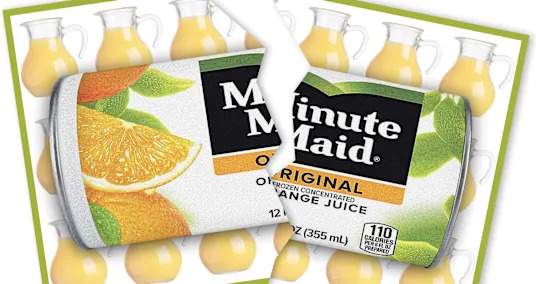
After 80 years as a staple in American households and at kids’ lemonade stands, Minute Maid frozen juice concentrates will soon be a thing of the past. Parent company Coca-Cola announced it will discontinue the entire line — which includes orange juice, lemonade, limeade, pink lemonade and raspberry lemonade — in the U.S. and Canada in April.
The product, which debuted with frozen orange juice concentrate in 1946, was once considered a breakthrough innovation, enabling “great tasting orange juice anytime of the year,” according to the Coca-Cola website. With frozen juice concentrates, people who lived far from where citrus fruits were abundant could still enjoy what felt like “fresh” juice, says culinary historian Sarah Wassberg Johnson.
Plus, the cans were affordable. “It hit the perfect sweet spot of value and ritual,” Jeff Galak, associate professor of marketing at Carnegie Mellon University’s Tepper School of Business, tells Yahoo. “It was significantly cheaper than fresh fruit, yet provided a sense of ‘productive labor.’ Much like early cake mixes, the simple act of adding water and stirring gave consumers a feeling of involvement in preparing a fresh breakfast.”
Why are frozen juice concentrates going away?
Once ready-to-drink juice hit the market in the 1970s, things started to change. “Consumer psychology shifted toward a freshness premium,” Galak explains. “As logistics improved, ‘Not From Concentrate’ (NFC) refrigerated cartons became the gold standard.”
To most modern shoppers, a frozen block of concentrated juice feels processed, while a carton feels more natural, Galak notes. But the final blow may be twofold: Orange production is down, and the thirst for juice in general — once a fixture of the classic American breakfast — is plummeting. “As a whole, Americans aren’t drinking as much juice because of the sugar content,” Johnson tells Yahoo.
Still, whenever a nostalgic staple starts to disappear from store shelves, it stings. As a result, fans have flooded social media with memories (“part of our childhood is officially coming to an end”), tributes (including “RIP legend”) and reactions (“This is legitimately heartbreaking”) to the old-school product getting canned. Here, people share what the product has meant to them.
‘It feels like the end of a small but very nostalgic era’
Peter Sanchez Guarda tells Yahoo that he’s “surprised and saddened” by the news. “Before I was old enough to help my mom with anything in the kitchen, I got to participate by making the OJ with the big wooden spoon and the jar,” he tells Yahoo. “I felt like I was really helping because she insisted, convincingly, that she couldn’t do it without me.”
But Guarda admits that he hasn’t had the juice concentrate in years. “That’s probably not unique, which is why it’s being discontinued,” he says. “But I have very fond memories of it.”
Elementary school teacher Hezekiah Herrera also remembers making Minute Maid juice concentrate growing up. “It was a ritual,” he tells Yahoo. “You would remove the metal lid, pour the frozen cylinder into a pitcher, then add three cans of water. There was something almost meditative about mixing it and watching the orange cloud disperse into liquid. It tasted like you had put some work into it, even though it took about 90 seconds.”
The canned juice product also represented “economic dignity” to many households. “It was a means by which low-income working families could stretch their grocery budgets, while still providing the kids with what they needed to eat,” Herrera says. “A can of Minute Maid concentrate cost nearly nothing and provided a week’s worth of juice. This wasn’t simply nostalgia — it was a form of infrastructure.”
Even younger generations recognize the impact the product had. Gen Z commentator and podcast host Ashleigh Ewald says that back in the ’80s and ’90s, juice concentrate was a common household item. “It was cheap, didn’t take up a lot of space and you could get a lot of juice out of one can,” she tells Yahoo. “I think this is why you saw the brand around every corner back then. It wasn’t something anyone made a big fuss over. Yet, I think the brand became a part of a lot of kids’ lives without anyone even realizing it.”
Millennial and former New York City Department of Education school lunch employee Victoria Fields says that “it feels like the end of a small but very nostalgic era.” For people who grew up in the ’80s and ’90s, she says it wasn’t just juice — it was part of childhood. “It reminds people of breakfast before school, summer days and parents making things work with what they had,” she tells Yahoo. “It also represents a time before everything came pre-bottled and individually packaged.”
Fields says the loss feels bittersweet. “Frozen juice concentrate is one of those small cultural touchstones that remind a lot of us of home, family kitchens and a simpler time,” she says. “It may seem like a small product to discontinue, but for many of us it carries a lot of memories.”
While Coca-Cola has stopped producing its frozen juice concentrates, you may still be able to find some in your local supermarket’s freezer aisle — for a little while, at least.
LATEST POSTS
- 1
 The pace of hiring just fell to the lowest since 2011, outside of the pandemic
 - 2Jeff Bezos’ Blue Origin launches landmark Mars mission in New Glenn rocket’s first big test
- 3Exposure to neighborhood violence leads some Denver teens to use tobacco and alcohol earlier, new study shows
- 4Reporter's notebook: Inside the IDF’s ‘Hamas Village,’ and how Israel is rewriting urban warfare
- 5Step by step instructions to Guarantee Your Fender bender Legal counselor has Areas of strength for a Record



- Must-Have Wellness Gear: What to Purchase for Successful Exercises
- Elite Execution Gaming PCs for Gamers
- Mossad unveils network of Hamas terror infrastructure across Europe
- Turkey, Egypt, Qatar discuss second phase of Gaza ceasefire deal
- Figure out How to Use Your Nursing Abilities for Better Compensation
- Ferrari Cavalcade Suspended After High-Speed Crash in Argentina Involving a Purosangue
- ‘Slender Man’ attacker back in custody. What we know about Morgan Geyser's disappearance and what happens next.
- Displaced Palestinian families suffer as heavy rains flood Gaza tent camps
- Why boosting production of Venezuela's 'very dense, very sloppy' oil could harm the environment


